Where life is curated, not performed
Since When Did Instagram Become the Modern Version of a Tupperware Party?
LIFESTYLE
5/21/20262 min read
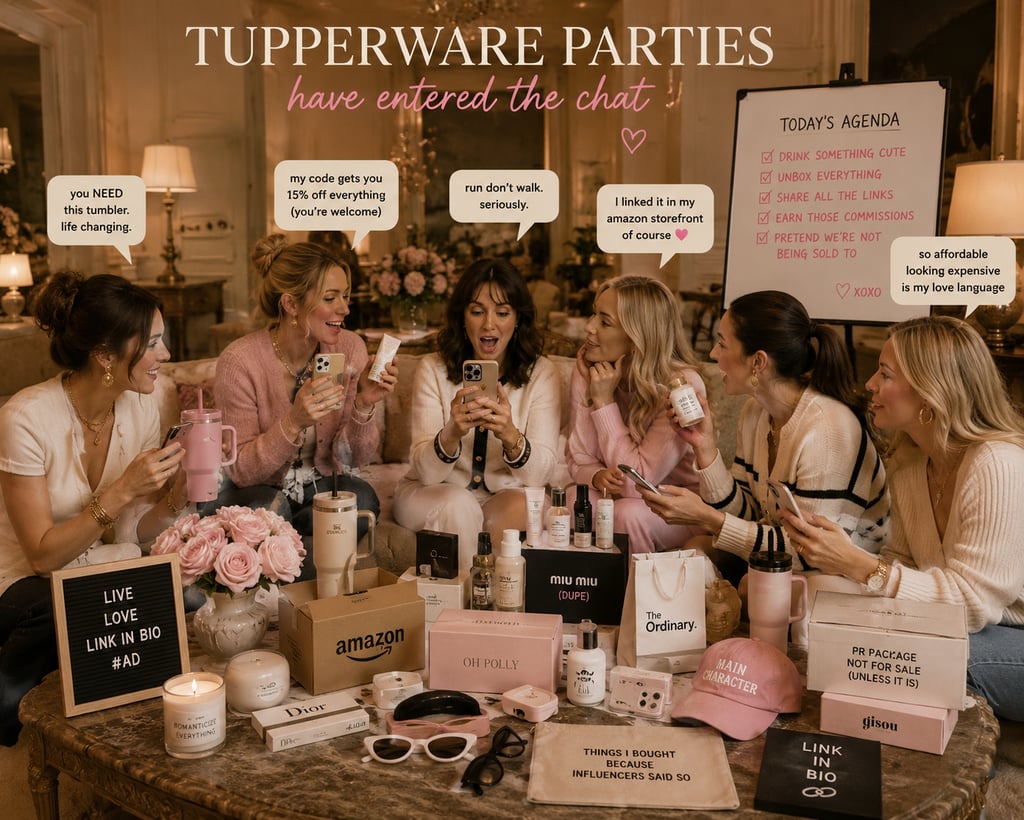
At some point, Instagram quietly transformed from a place where people shared their lives into a giant digital Tupperware party.
And I mean that with love. Sort of. Maybe not, actually.
Remember Tupperware parties? Your mom would get invited by a neighbor who somehow convinced twelve exhausted women to gather in a living room on a Tuesday night to discuss plastic containers as if they were revolutionary scientific discoveries. There would be suspiciously dry brownies, lukewarm coffee, and at least one woman aggressively insisting that this particular lid would “change your life.”
Well. Welcome to 2026!
Now the pressure is algorithmic, and the lids have been replaced with Hill House dresses, “life-changing” collagen powders, Amazon cardigans, beige water bottles, Miu Miu sunglass dupes, and LED face masks that promise to reverse time itself.
Scroll for seven seconds and someone is breathlessly informing you that you absolutely need a $300 candle warmer, a viral tennis skirt, twelve shades of lip oil, a machine that makes “wellness ice,” or a pair of orthopedic sandals styled as “quiet luxury.”
And listen, I’m not anti-stuff. Of course, not! That would be highly hypocritical to even try to pretend. I love beautiful things. I love aesthetics. I love a gorgeous occasional unnecessary-but-fabulous purchase that sparks genuine joy. Human beings have always collected beautiful objects. That’s not the issue.
The issue is that somewhere along the way, consumption stopped being occasional pleasure and quietly became an entire personality trait.
Everything now is:
“RUN don’t walk.”
“You NEED this.”
“I’m obsessed.”
“This changed my life.”
“Add to cart immediately before civilization collapses.”
We are being marketed to with the emotional urgency of an Amber Alert over a pair of viral jeans.
And what fascinates me most is how blurred the line has become between authentic recommendation and commission-driven persuasion. Because once upon a time, recommending something to a friend was intimate. Genuine. Human. You told someone about a moisturizer because you actually loved it, not because you had a personalized affiliate link waiting in your bio like a digital fishing hook.
Now every interaction online feels slightly… monetized. Just like when Vivian stayed at the The Beverly Wilshire with Richard Gere in Pretty Woman and started casually referring to it as “home” while everyone collectively understood there was… technically a financial arrangement involved!
Sorry, i'm a millenial, i like a good reference, what can i say?
The real question is: Is your favorite hit girl genuinely love the product?
Or is she making 12% commission if I buy it in the next four minutes?
The best things i've tried, were honest to god, not that impressive, and definitely NOT life changing. The worst, were just a complete waste of money.
And honestly? I don’t even blame influencers. The system itself rewards constant consumption. Algorithms reward novelty. Newness. Hauls. Dupes. “Must-haves.” Overconsumption has become entertainment disguised as lifestyle inspiration.
We’ve created an economy where people are made to feel simultaneously:
not rich enough
not stylish enough
not organized enough
not glowy enough
not trendy enough
…until they buy the next thing.
I think we’re reaching collective exhaustion with it.
And honestly?
The most chic thing someone can have in 2026 might just be discernment.
Not the biggest haul.
Not the trendiest shelf.
Not the twenty-step skincare routine.
Just a sound sense of judgment, personal taste, and the radical ability to decide:
“Actually… I don’t think I need that.”
Join our newsletter for fresh lifestyle tips
Say Hello!
© 2025. All rights reserved.